Yes, quantum hardware is commercially available, including small educational devices and specialized systems for institutions. But buying one is not like choosing a faster desktop PC. You need to distinguish a teaching instrument, a research installation and a service that provides access without transferring ownership. For most beginners, a simulator and limited cloud access are more useful starting points than a hardware purchase.
Three different offers can use the same label
An educational quantum device is designed to demonstrate a limited set of concepts or experiments. A research system is designed around more demanding control, performance and integration requirements. Cloud access lets you submit work to hardware operated elsewhere. All three may appear in discussions about getting a quantum computer, but they solve different problems.
An on-premises arrangement introduces another distinction. A machine can be installed at your institution while remaining part of a managed service or contractual access arrangement. Physical location does not automatically establish outright ownership, unrestricted control or the right to modify every component.
I would begin by writing one sentence that describes the intended outcome: teaching a class, studying a device, developing algorithms or running a defined research workload. If the seller’s offer does not clearly support that outcome, its quantum label is not enough to make it the right purchase.
Educational hardware is real but deliberately limited
Small teaching instruments can make quantum experiments tangible in a classroom. Some use nuclear magnetic resonance, or NMR, to manipulate and observe nuclear-spin behavior. Their value lies in access to experiments, controls and teaching material, not in replacing a powerful classical workstation.
SpinQ’s university laboratory offerings include desktop NMR equipment and experimental platforms intended for quantum education. The manufacturer describes software, courses and hardware access as parts of the teaching setup. That is a concrete product category, rather than a general claim that consumer quantum PCs have arrived.
When assessing such an instrument, ask which experiments are supported and what students can change. Can they design circuits, inspect measurements or work with pulse-level controls? Are the lessons appropriate for their mathematical background? A device with a polished interface may still be unsuitable if the course requires access it does not expose.
Do not infer useful large-scale quantum advantage from a small educational demonstration. A teaching system can be worthwhile even when its example calculations are easy to reproduce classically. Its purpose may be understanding the physical process, much as an electronics laboratory uses simple circuits to teach principles rather than outperform a commercial processor.
Research systems require a site and a support plan
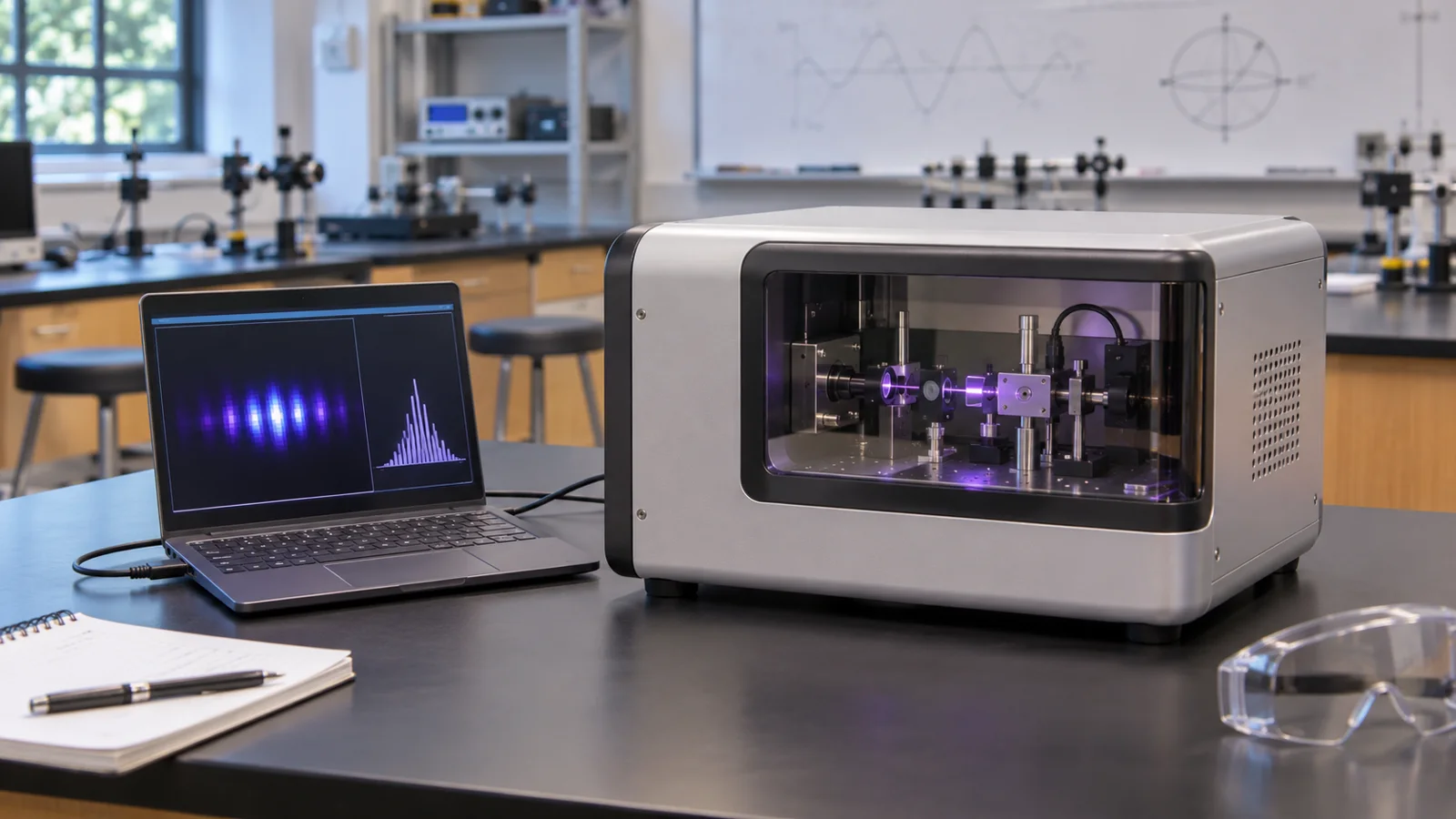
A research installation involves more than a processor package. Depending on the platform, it may require cryogenic equipment, vacuum hardware, optical systems, specialized control electronics and suitable laboratory infrastructure. The exact requirements must come from the proposed system, not from a generic photograph of quantum hardware.
Staffing is part of the decision. Someone must understand operation, calibration, maintenance and the interpretation of results. A supplier may provide some of that support, but the division of responsibilities should be explicit. Delivery alone does not establish that your team can carry out the intended experiments.
Specify acceptance tests before the purchase. A useful agreement identifies supported operations, relevant performance measures, documentation, training and the conditions under which the system is considered commissioned. A qubit count by itself is too weak because it does not describe how effectively those qubits can be used.
Also ask about upgrades and repair. Research hardware evolves, and replacing a component can affect software or calibration procedures. A system that appears affordable at acquisition may become difficult to operate if essential support, spare parts or interface documentation are unavailable.
Cloud access often answers the beginner's actual need
If your goal is to write and run quantum circuits, ownership is usually not required. A cloud service can provide access to a remotely operated processor while your ordinary computer handles programming and analysis. You still need to understand the device’s constraints and the service’s current access conditions.
Cloud access and simulation should not be confused. A simulator runs a model on classical hardware. A quantum processing unit executes a physical experiment. Both can appear behind similar software interfaces, so verify which backend a tutorial or demonstration actually uses before interpreting its output.
For a first project, a local simulator provides a controlled reference. You can predict a small circuit’s ideal behavior and debug mistakes without waiting for a remote device. Hardware access becomes useful when you have a specific question about noise, mapping or physical execution.
My recommendation for an individual learner is to spend effort on a clear experiment before spending money on equipment. If you cannot yet explain what a purchased device would let you investigate beyond simulation and cloud access, the purchase decision is premature.

Check capability, ownership and total cost separately
Capability asks what the system can do. Ownership asks what you are acquiring and which rights come with it. Total cost asks what you must pay to keep using it. A proposal can look attractive on one dimension while being unsuitable on another, so keep these questions separate during comparison.
For capability, ask for demonstrations matched to your intended workload rather than a generic showcase. For ownership, check whether the arrangement is a purchase, lease or managed service. For cost, identify installation, delivery, local taxes, service, training and software commitments. Avoid treating a headline figure as the complete budget.
Region and availability can also matter. A product page does not guarantee immediate delivery to every country or eligibility for every service. Ask for a current quotation and site requirements through the manufacturer’s normal sales process. Do not rely on an old article’s converted currency figure as a binding offer.
When comparing proposals, insist on the same scope. An instrument supplied without installation cannot be compared directly with a fully commissioned system including support. Equally, a small educational device and a research-grade platform should not be ranked by price per qubit as though their capabilities were interchangeable.
Recognize promises that do not match the technology
A quantum computer is not a universal accelerator for gaming, video editing or ordinary office work. Its potential benefits depend on algorithms and tasks that can use quantum information processing. A seller claiming automatic speedups for every application should explain the actual architecture and provide workload-specific evidence.
Be especially cautious when a product combines quantum language with guaranteed investment returns, secret trading advantages or unexplained claims about breaking any encryption. Those claims do not follow from the existence of commercially available quantum hardware. A scientific term is not evidence that a financial promise is sound.
For a legitimate technical purchase, the documentation should make the scope understandable. You should know what physical system is involved, which operations are supported and what the results mean. A refusal to distinguish simulation from hardware, or access from ownership, is a reason to pause the decision.
The sensible buying route is therefore conditional. Choose educational hardware for a defined teaching benefit, a research system for a justified experimental capability and cloud access for suitable remote workloads. If the goal is simply to start learning, begin with software and mathematics; ownership can wait until it solves a specific problem.
Frequently asked questions
Can I keep a quantum computer at home?
Some compact educational instruments are designed for ordinary teaching environments, subject to their operating requirements. That does not make a research-grade quantum installation practical for a typical home. Check the exact device rather than assuming all quantum computers share one size or infrastructure need.
Will it replace my gaming PC?
No. Educational and research quantum devices are not general replacements for a gaming computer. Their interfaces, workloads and output are different. Keep a conventional computer for ordinary applications and use quantum tools only where the experiment or algorithm calls for them.
Does on-premises mean I own the machine?
Not necessarily. On-premises describes where the system is installed. The agreement may provide dedicated access, a lease or a managed service. Read the commercial terms and support responsibilities before treating physical possession as outright ownership or unrestricted modification rights.
What should a teacher ask before ordering?
Ask which experiments students can perform, what prerequisites they need, how many can use the system, and what training and support are included. Request a demonstration tied to your curriculum. The educational outcome matters more than an impressive enclosure or a raw qubit count.