The cost depends on what you mean by a quantum computer: limited cloud access can be free, paid experiments can be billed by usage, and a dedicated research installation requires a quotation. There is no single retail price covering all three. For a practical budget, first separate the price of using hardware from the cost of obtaining and operating a physical system.
Start with the kind of access you need
A learner working through small circuits has different requirements from a university developing hardware or a company reserving substantial processor capacity. Comparing their spending without identifying the workload produces a misleading price range. The cheapest useful option is the one that supports the specific task, not necessarily the one with the lowest advertised unit rate.
Local simulation is often the starting point. It uses your existing classical computer to model small quantum circuits, so there may be no additional service charge. It still consumes your own computing resources, and it is not execution on physical quantum hardware. Larger cloud simulations can be separately billed.
Limited free QPU plans are another category. They offer access under defined allowances and eligibility conditions. A free tier does not establish the price of unrestricted use, and promotional credits should not be treated as permanent budget assumptions. Check the plan you will actually use after any introductory allowance ends.
A worked example of a paid quantum job
Amazon Braket’s quantum service pricing lists on-demand task and shot charges that vary by device. At the November 2026 check, IQM Emerald is listed at US$0.30 per task plus US$0.00160 per shot. A shot is one execution of the submitted quantum experiment.
For a hypothetical eligible task containing 1,000 shots, the listed QPU charge is US$0.30 plus 1,000 multiplied by US$0.00160, which equals US$1.90. This calculation covers that task’s stated QPU fees only. It does not include taxes or separately billed supporting services, and it is not a quotation for every device.
The example shows why the number of repetitions matters. A program that submits many circuits or repeatedly updates parameters can create many tasks, not one. Before running a loop, estimate how many submissions it makes and how many shots each submission requests. A small per-task charge can accumulate across a large experiment.
Do the calculation using the current rate for your selected backend. Do not substitute a price from another processor merely because both are described as quantum computers. Supported operations, available capacity and experimental usefulness also matter, so the cheapest shot is not automatically the best value.

Time-based plans answer a different budgeting question
Other services sell measured processor time or contracted capacity. IBM’s product page, checked in November 2026, lists Pay-As-You-Go access starting at US$96 per minute, billed per second, and an on-premises offering whose price requires a quote. These are service arrangements, not the retail purchase price of a bare processor chip.
You cannot compare a per-minute rate directly with a per-shot rate without knowing how your workload maps to each billing system. A circuit’s duration, repetitions, overhead and service accounting rules can affect the result. The appropriate comparison is the estimated charge for the same useful experiment.
Contracted plans may involve minimum commitments or a period in which capacity must be used. A lower unit rate can still be a poor choice if you do not need the committed quantity. Compare total expected spending and usable capacity, rather than treating the smallest displayed rate as the cheapest plan.
I would begin with a small, controlled workload and inspect its resource use before estimating a larger project. That gives the budget a measured foundation. It also reveals whether your real bottleneck is device access, classical preparation or an experiment design that requests more repetitions than necessary.
Physical systems need a complete quotation
Educational hardware and research installations occupy different price categories and offer different capabilities. A compact teaching device can support useful demonstrations without being comparable to an institutional processor. A research system may require specialized facilities, installation and continuing support beyond the hardware itself.
Ask a vendor to state exactly what the quotation includes. Delivery, site preparation, training, software, service and local taxes may be separate. The agreement should also identify the acceptance criteria and responsibilities after installation. A cabinet arriving at the site is not the same as a commissioned system performing the intended experiments.
Public research budgets can indicate the scale of investment, but they are not interchangeable with a retail price. A programme may pay for development and validation across several systems, while a purchase quotation may assume an existing laboratory and trained staff. Use those figures for context, not as a universal price per machine.
For an organization considering ownership, compare the value of physical access with hosted alternatives. Device research may require controls that a cloud service cannot expose. An algorithms team may gain little from owning the cooling or optical infrastructure. The reason to own hardware should be tied to a capability you actually need.
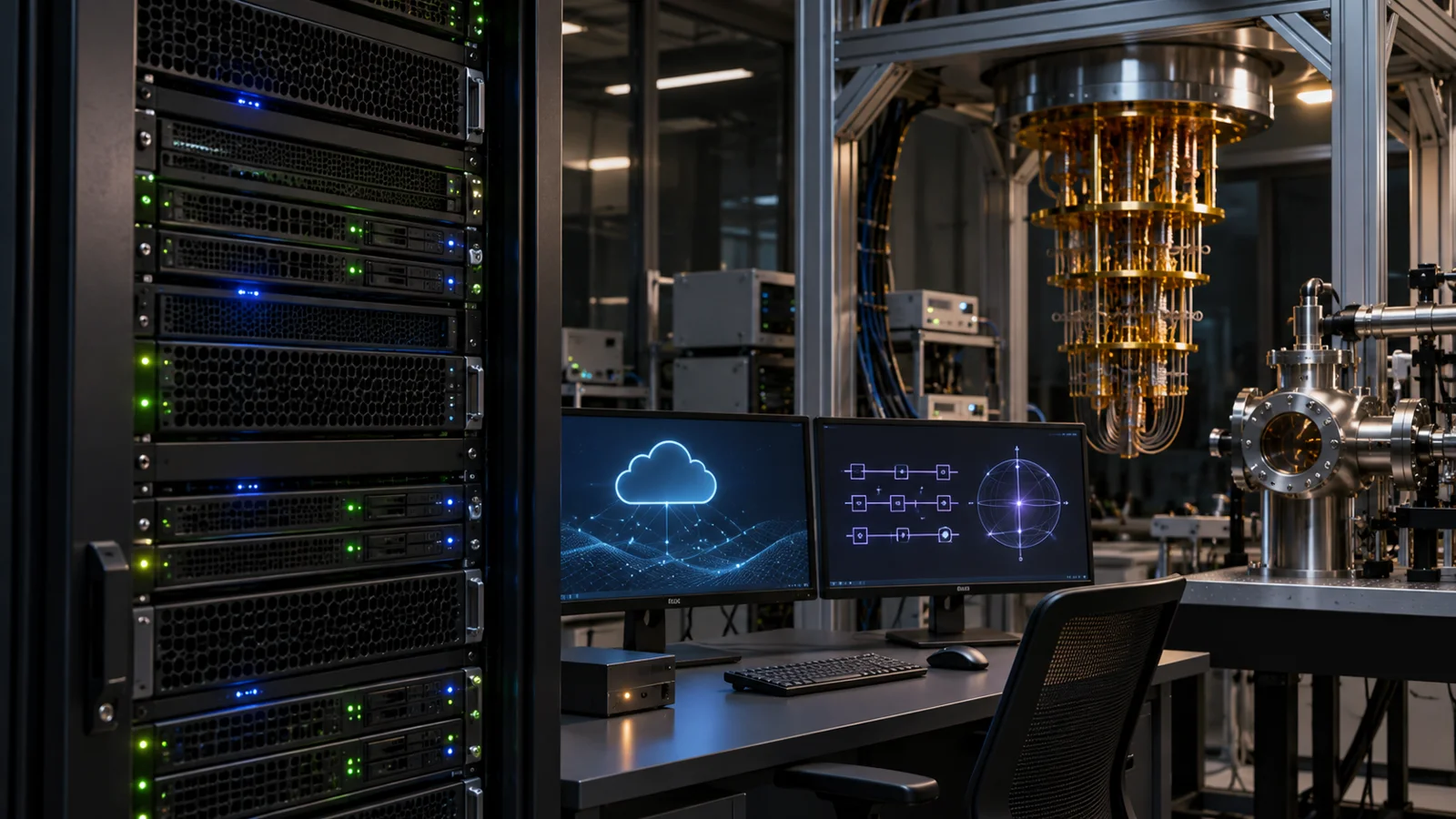
Remember the costs surrounding the quantum task
A quantum workflow usually includes conventional computing for preparation and analysis. Depending on the service, notebooks, storage, job instances or other cloud resources may be billed separately. Leaving a development environment running can therefore cost money even when no quantum circuit is executing.
Error-management techniques and repeated experiments can also increase resource use. A polished result may require more than the single circuit shown in a diagram. Parameter sweeps, calibration-related checks and multiple measurement settings should be included when they are part of the planned workflow.
For physical ownership, recurring costs can include staff, maintenance, utilities, service agreements and replacement components. Their importance depends on the system and contract. Do not assume that paying the initial invoice removes the need for technical support or continuing operating expenditure.
A useful budget has two boundaries: what resources are included and what time period is covered. State both. A one-off classroom demonstration, a month of exploratory research and several years of laboratory operation are different financial questions, even when they use similar vocabulary.
Choose a budget that matches the next decision
For a beginner, I would start with local simulation and a clearly limited hardware allowance. The first objective is to learn how to construct, validate and interpret a small experiment. Buying equipment or committing to substantial capacity before that stage usually adds cost without answering a better question.
For a research project, estimate the number of circuits, repetitions and iterations required, then identify supporting resources. Run a small representative pilot where possible. Use its resource consumption to refine the estimate, while allowing for changes in device availability and the needs of the actual experiment.
For a hardware purchase, request scope-matched proposals and compare total cost over a stated period. Include the people and infrastructure already available at your organization so that you do not confuse an incremental cost with the cost of starting from nothing.
The sensible answer is therefore a menu of access models, not one universal price tag. Free allowances can support learning, paid jobs can support limited experiments, and dedicated installations require a much broader proposal. Choose the model only after defining the work, then verify the current rate and what it excludes.
Frequently asked questions
Can I use quantum computing without paying?
Some local simulators and limited cloud-access plans are free to use within their conditions. A simulator uses classical hardware, while a QPU plan provides physical-device access. Check eligibility and limits, and do not assume an introductory credit continues indefinitely.
Is a quantum-computing minute the same as a minute online?
No. A service’s billing unit usually refers to defined resource consumption, not simply the time you spend viewing its website. Read the usage definition for your plan. Preparation, queueing and supporting cloud services may be treated differently from processor execution.
Why do many hardware pages require a quote?
The configuration, site requirements, support and installation scope can differ between customers. A quotation lets the supplier define those details. It also means that a number from an old news article should not be treated as a current offer for your own location or requirements.
Should I convert a dollar price directly into rupees?
A currency conversion gives only a rough comparison. Your payable amount can also depend on taxes, billing currency, payment charges and the supplier’s regional terms. Use the actual checkout or quotation for a purchase decision rather than an undated converted figure.